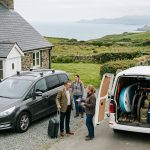










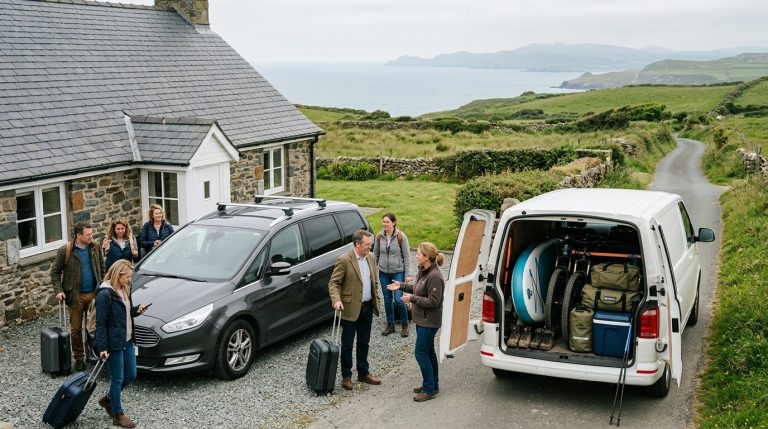
A two-centre holiday in Wales sounds simple until you count what’s coming. Six people, two bikes, a paddleboard, walking kit, a cool box and a week of luggage don’t fit the same vehicle, and they don’t have to.
The useful question isn’t “what should we hire?” It’s “what has to move, between which stages, and on which days?” Answer that and the vehicle choice usually follows. Often the answer is two separate things: a way to move people, and occasionally a way to move gear.
Split the trip into stages
Write the holiday down as legs, not as a destination. A typical shape might be: drive from home to an inland base in Mid Wales, spend three nights there, move to the Llŷn coast for four nights, then go home. That’s three moving days, and each can have different needs.
For each leg, note:
- how many people are travelling that day
- what bulky items move with them
- whether anyone could travel separately, for example by train
- what the accommodation says about parking and access
Rail is worth a look for at least part of the group. Transport for Wales describes the Cambrian line as running between Pwllheli, Aberystwyth, Machynlleth, Newtown, Shrewsbury and the stops in between. That means an inland stay near Newtown and a coastal stay near Pwllheli sit on the same line. Some of the party could travel light while the luggage goes by road. Check current timetables before relying on it.
People first: what the licence and seats allow
Seats decide the passenger plan. A standard car licence covers vehicles with up to 8 passenger seats, within the weight limits set out on GOV.UK’s licence categories page. Larger minibuses are a different matter. GOV.UK’s minibus guidance explains that driving one on a car licence is only possible under specific conditions: no payment from or on behalf of the passengers, a driver aged 21 or over who has held the licence for two years and is driving voluntarily for a non-commercial body’s social purposes, no trailer, and a weight limit of 3,500kg (4,250kg for electric or hydrogen vehicles). A family or friends’ holiday is unlikely to meet them, so in practice a minibus usually needs a driver with D1 entitlement. Check the actual licence of whoever will drive before booking anything with more than eight passenger seats.
Don’t assume the advertised seat count either. Ask for the exact vehicle and how many seats it has with luggage on board. A “9-seater” with nine people in it may leave very little room for bags.
And to be plain about it: a goods van carries people only in its cab seats. The load area is for gear, never passengers.
Gear second: when a separate van makes sense
A van is worth considering when the bulky items are what’s making the passenger plan awkward. Bikes, boards, camping kit or a family’s worth of luggage can push a group from one car into two. Sometimes one car plus a small van, used only on moving days, is simpler. Sometimes a roof box is enough. For walkers, the Wales Coast Path website keeps a directory of luggage-transfer and planning services, including some covering Llŷn. It notes that it makes no guarantees about the listed businesses.
Options at a glance
| Option | Moves | Good for | Check before booking |
|---|---|---|---|
| Train on the Cambrian line | People, light bags | Part of the group travelling between an inland and a coastal base | Current timetable, bike reservations, how to get from the station to the accommodation |
| Car or people carrier hire near the coast. Example: Pwllheli vehicle hire options (Wales Rentals lists cars, vans, minibuses and trucks for Pwllheli and says bookings are taken by phone) | People | Getting around Llŷn once you’re there | Exact vehicle and seat count, licence requirements, delivery address, insurance excess |
| Goods van inland. Example: van hire information for Newtown (the page covers Newtown/Y Drenewydd and lists vans from a long-wheelbase Transit up to Lutons with tail lifts) | Gear only, plus cab seats | Moving bikes, boards or bulky luggage on changeover days | Whether a one-way return is possible, load length, deposit, mileage terms |
| Luggage transfer service | Bags | Walking holidays along the coast path | Coverage area, cut-off times, weight limits |
The two hire examples are different websites covering different parts of Wales, and nothing on either page establishes who operates them. They are not a combined booking and haven’t been compared with other providers. Confirm every detail directly, especially anything about delivery, one-way returns or seat numbers.
Packing and vehicle-choice worksheet
Fill this in for each moving day. If any line is blank, that’s the question to ask the accommodation or the hirer.
| Question | Leg 1: home → inland | Leg 2: inland → coast | Leg 3: coast → home |
|---|---|---|---|
| People travelling by road | |||
| People who could go by train | |||
| Drivers and their licence categories (checked) | |||
| Bulky items (longest length) | |||
| Seats confirmed in the exact vehicle, with luggage | |||
| Accommodation parking: spaces, height limits, lane access | |||
| Hire collected / returned where and when |
Ask the accommodation about access
Rural cottages and farm stays in Wales can sit at the end of single-track lanes, with a gate, a steep yard or two parking spaces. Before you book a larger vehicle, ask the host whether it will fit, where it can be left, and whether there’s anywhere to turn. A hired van that can’t get up the drive turns into an extra trip with armfuls of bags.
Match the returns to the itinerary
The last thing to check is how each hire ends. A van used only for the inland-to-coast changeover is no help if it must go back to where it started the same afternoon. Ask about one-way returns, collection from your accommodation and the exact return time, and write them in the worksheet. If the return doesn’t fit the travel day, a different split may work better. For example, the group could hire for the coast stage only and send the bulky gear ahead some other way.
A hypothetical example: a group of seven plans three nights near Newtown and four near Pwllheli. Two people take the train along the Cambrian line with day bags. Five travel by road. On the two changeover days, three of them go by car while the bikes and boards go in a small van, driven by the fourth with the fifth in the cab. Nobody travels in the back. Whether that’s cheaper or easier than two cars depends entirely on the quotes and return terms, which is why it’s worth writing down before you call anyone.